Did you know that 87% of beginner guitarists struggle with timing issues in their first year? We’re about to fix that. Keeping time isn’t just about following a beat – it’s the foundation that separates amateur noodling from professional musicianship. If you’ve ever felt lost during a jam session or struggled to maintain consistent rhythm, you’re facing a common but solvable problem. Let’s transform your timing from shaky to rock-solid with proven techniques that work for players at any level.
Understanding the Fundamentals of Musical Time
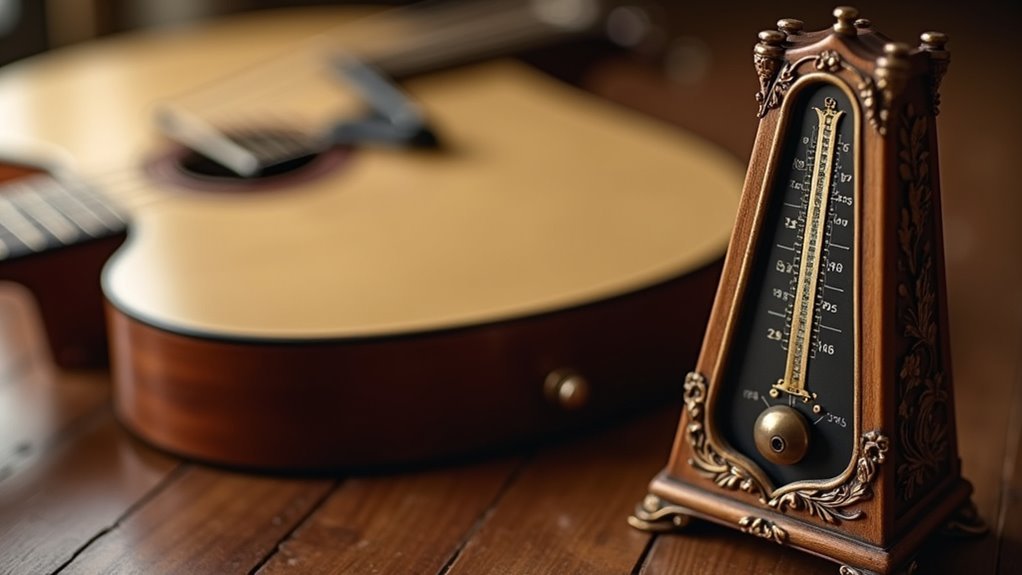
When it comes to playing guitar with solid timing, nothing’s more critical than mastering the fundamentals of musical time.
We’ll start with the basic building block: the measure. In 4/4 time, we’ve got four beats per measure – the foundation we’ll use to stay in sync with any song.
Let’s get hands-on. Set your metronome to 60 BPM and count the beats: “1-2-3-4.” Feel that steady pulse? That’s your rhythm anchor.
Now subdivide those beats into eighth notes: “1-and-2-and-3-and-4-and.” We’re building layers of rhythmic feel that’ll make your playing rock-solid.
Want to spice things up? Throw in some triplets. They’ll divide each beat into three parts, adding that perfect dash of complexity to your timing toolkit.
Mastering Basic Beat Counting Techniques
Since we’ve covered the fundamentals, let’s plunge into beat counting – your ticket to rock-solid timing.
Let’s start with 4/4 time signatures, the bread and butter of modern music. Count “1-2-3-4” while you tap your foot to feel the beat. It’s simple but essential. We’ll use a metronome set between 60-80 BPM to keep time – no cheating or rushing ahead.
Once you’ve got the steady beat, add downstrokes on each count.
Ready for more? Let’s tackle subdivisions: “1 and 2 and 3 and 4 and.” This rhythm practice opens up new playing possibilities.
Finally, play along with backing tracks or drum loops – they’re your new best friends for developing real-world timing skills. Remember, great guitarists aren’t just playing notes; they’re grooving with precision.
Developing Your Internal Metronome

A rock-solid internal metronome is your secret weapon for flawless timing.
We’ll build this essential skill through consistent practice and proven techniques that’ll revolutionize your rhythm playing.
Start by tapping your foot to your favorite tracks. It’s deceptively simple but incredibly effective.
Tapping along to music is your first step toward rhythmic mastery – a simple exercise with profound impact.
Next, play along with a drum machine at a modest 60 BPM – trust us, start slow. As you nail the basics, gradually increase the tempo.
Want to level up? Practice handling changes in tempo by alternating between double-time and half-time rhythms.
Mix up your routine by maintaining a steady beat while jamming with different time signatures.
Your internal metronome will strengthen with each session, transforming you from a timing amateur into a rhythmic powerhouse.
Essential Rhythm Practice Exercises
Building essential rhythm demands a relentless focus on fundamental exercises that’ll transform your timing from shaky to unshakeable.
We’ll start by setting your metronome to 60-80 BPM, playing downstrokes to maintain a steady rhythm guitar foundation. Let’s strengthen your sense of timing by counting “and” between beats, mixing downstrokes and upstrokes while playing along.
To master time signatures and beats, tap your foot while strumming – it’s non-negotiable for developing rock-solid timing.
Ready for the next level? Introduce triplets by counting “trip-let,” using alternating strokes. Practice with backing tracks at slow tempos first, then gradually increase speed.
Remember: your internal clock is like a muscle – it gets stronger with consistent, focused practice.
Advanced Timing Techniques and Patterns
Once you’ve mastered basic timing, it’s time to plunge into the deep end of rhythmic complexity. To refine your timing as a rhythm guitarist, we’ll explore advanced subdivisions and syncopation. Let’s break down essential tips that’ll transform your playing guitar prowess.
| Technique | Beats Per Bar | How to Practice |
|---|---|---|
| Eighth Notes | 8 | Count “1-and-2-and” |
| Triplets | 12 | Say “trip-let” |
| Sixteenth Notes | 16 | Use metronome |
| Syncopation | Varies | Omit strong beats |
To stay in time while playing these patterns, start slow with a metronome. Gradually increase tempo as you master each subdivision. Combine upstrokes and downstrokes to create dynamic rhythms. Practice clapping and counting aloud – it’s not optional. These techniques demand precision, but they’ll revolutionize your playing.
Tools and Technology for Timing Improvement
Modern technology has transformed how we master guitar timing – and you’d be a fool not to leverage it. We’ve got powerful tools that make keeping time easier than ever, from drum beat apps to loop pedals. Set the metronome at a slower tempo, then gradually increase it as you nail those strumming patterns.
Don’t ignore modern tech for learning guitar timing. Smart tools like metronomes and drum apps can fast-track your rhythmic development.
- Time Trainer and Pro Metronome apps let you feel the pulse at various speeds, even handling complex time signatures and double time patterns.
- Drum Genius provides authentic backing tracks that help you groove while practicing – you’ll be able to feel the rhythm naturally.
- Record yourself and use loop pedals to create practice tracks, revealing where your timing needs work.
These tech tools, combined with structured video lessons, will transform your timing from amateur to pro-level precision.
Troubleshooting Common Timing Challenges

While many guitarists get tripped up by common timing issues, we’ve got battle-tested solutions that work. Let’s tackle these head-on with proven strategies to keep your playing tight and precise.
| Challenge | Solution | Result |
|---|---|---|
| Lost Beats | Play every beat with metronome | Solid foundation |
| Choppy Changes | Tap foot during chord changes | Smoother shifts |
| Rush/Drag | Count out loud while playing | Consistent tempo |
| Poor Flow | Use backing tracks regularly | Real-world timing |
Recording your practice reveals timing flaws instantly – there’s nowhere to hide. Start by tapping your foot on every beat while playing chord changes. When that’s solid, layer in backing tracks to test your timing against real music. Remember: perfect timing isn’t natural – it’s built through deliberate practice and honest self-assessment.
Frequently Asked Questions
What Is the 80/20 Rule Guitar?
We’ll get better results by focusing our practice strategies on the essential 20% of learning techniques that yield 80% of our progress, helping us manage time and set goals effectively.
What Is the 10000 Hour Rule for Guitar?
While there’s no magic number, we’ve found the 10,000-hour rule suggests mastery through consistent practice and effective techniques. It’s about quality time investment, goal setting, and tracking our progress toward skill mastery.
How Many Hours Should I Play Guitar a Day?
We recommend starting with 30 minutes daily, gradually increasing as your skill improves. Consistent practice routines are more effective than sporadic long sessions. Match your daily goals to your learning style and available time.
How to Play 1/2 3/4 on Guitar?
Like a heartbeat, let’s master strumming patterns in 1/2 and 3/4 time through rhythm exercises. We’ll use metronome usage, counting beats, and smooth chord changes while practicing finger placement across different musical genres.